
We are pleased to announce the winners of the NINO BA and MA Thesis Prize 2025:
◊ BA Thesis, First Prize: Lidwien Meulenkamp
◊ BA Thesis, Runner-up: Tim Claessen
◊ BA Thesis, Runner-up: Olaf de Greeff
◊ MA Thesis, First Prize: Kiki Freriks
◊ MA Thesis, Runner-up: Lauren van Kruijssen
The prizes consist of € 400 for the best BA thesis and € 600 for the best MA thesis. The runners-up receive an honorable mention. 17 theses, all graded with an 8 or higher by their supervisors, competed this year. They were written at three different universities in the Netherlands for different study programs:
Ancient Near Eastern Studies, Archaeology, Classics and Ancient Civilizations, Military History, Middle Eastern Studies and History and International Studies.
We thank our jury for evaluating the competing theses in two rounds, next to everyone’s busy schedules. Awarding the prizes would not have been possible without our 17 jurors: Dr D. Braekmans, Dr R. Demarée, Dr. B. Garnand, Dr S.M.T. van Gompel, Dr J. Grotenhuis, Dr D. Halbertsma, Dr D. Katz, Dr J. Kelder, Dr I. Peled, Dr A. Planelles, Dr J.H. Plug, Dr P. Sijpesteijn, Dr N.T.B. Staring, Dr J. Stökl, Dr B. Suchard, Dr J. Swerida, Dr J.A.C. Vroom.
The jury selected two winners and three runners-up.
The award ceremony, including short presentations by the BA and MA Prize winners, is part of the NINO Annual Meeting on 29 January 2026.
BA in Archaeology, Leiden University; thesis supervisor: Dr B.S. Düring; second reader: Drs Annemieke Verbaas.
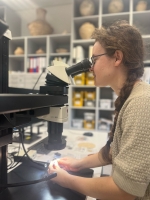 Repurposed and recycled perforated ceramic sherds are a ubiquitous find at excavations of archaeological settlements. They originate from pottery vessels that were broken during use, yet subsequently repaired to store food, drink or eat from again. These ceramic vessels are repaired by drilling fastening holes into their broken sherds, through which a piece of twine and plaster fastens them together again. However, some sherds are recycled differently, by modifying them into a circular shape with a central perforation. These perforated discs are frequently classified as miscellaneous objects by archaeologists, and subsequently their typifying metric characteristics, production, use and deposition are under-investigated. In addition, discs are popularly interpreted as expedient spindle whorls, weights, pot lids, gaming pieces and pottery scrapers, based on their general appearance and find contexts – yet their actual signs of use are not taken into account.
In this study, I used microwear analysis as a new method of approach to unravel the use of these perforated discs from the Chalcolithic site Chlorakas Palloures. Using a stereo- and metallographic microscope, each miniature scratch, crack and polish visible on the surface of the sherds could be recorded. These signs of contact all result from the pottery’s production, use and discard, which form a blueprint or biography of the actions that recycled the disc. Archaeological experiments were subsequently designed to test the hypothesized actions of repurposing the discs.
To contextualize the Palloures sample with assemblages from five other Chalcolithic sites, the metric dimensions of the 17 perforated discs were recorded to identify shared attributes. The Palloures discs share characteristics in flaked or rounded edges and biconical perforation profiles. Their diameter, thickness, weight and perforation diameter are similar within the sample, as well as to discs of nearby Chalcolithic sites. Microwear production traces indicate that direct percussion was applied to flake the discs’ edges and that flint perforators were used to drill the discs’ centers. Use traces, on the other hand, indicated a multitude of actions: ground edges may relate to hide or pottery scraping, the exterior abraded surfaces to polishing pottery, and their indented perforations to suspension through rope. The research thus revealed surprisingly diverse use traces on rather unassuming artefacts, and demonstrates the timeless possibilities of daily recycling from the past to the present.
“Dit is een werkelijk uitstekende studie. Juist omdat het een materiaal groep betreft die overal is gevonden en bijzonder onaantrekkelijk is, is het belang van deze studie groot, en de keuze om hier een BA thesis over te schrijven opmerkelijk. Deze scriptie verdient mijns inziens bijzondere lof – en de auteur aansporing om hier een wetenschappelijk artikel van te maken.”
Translation: "This is a truly excellent study. Especially because it concerns a material category that is found everywhere and yet is particularly undervalued. It highlights the extensive importance of this thesis and makes the choice to write one's BA thesis on it all the more interesting. This thesis, in my opinion, deserves special laudation, and the author is encouraged to turn it into a scientific article."
Classics and Ancient Civilizations: Egyptology; thesis supervisor: Dr B.J.J. Haring; second reader: Dr K. Donker van Heel.
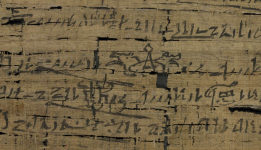 The ancient Egyptian hieroglyphic script is well known to be pictorial: every sign depicts an entity or object in the real world. While it is important to consider that in most cases, hieroglyphic signs simply represent sounds, there is no doubt that the pictorial nature of the script provided a scribe with a wealth of creative opportunities. Next to the monumental hieroglyphic script, however, the ancient Egyptians made use of the cursive hieratic script, usually written with ink on papyri or ostraca, and used for more practical purposes. Egyptologists nowadays prefer to transcribe the more variable hieratic script into standardised hieroglyphs, subsequently disregarding the original hieratic in order to study a text’s content. The influence of pictoriality in hieratic is considered to be practically nonexistent, especially in documentary texts. However, while the hieratic script may have lost much of the pictorial character of its hieroglyphic counterpart, it was never completely devoid of it. Scribes of hieratic had many of the same opportunities for visual creativity at their disposal as their colleagues writing hieroglyphic texts. But while the iconicity of the hieratic script is occasionally commented upon in text publications, it has never been the sole subject of study.
These considerations form the point of departure for this thesis, in which a selection of texts from various genres is analysed in order to determine to what extent a writer of hieratic made use of the iconicity of the script. Underlying this central aim are questions such as: to what extent was a writer of hieratic aware of the pictorial nature and iconic possibilities of their script? And, in cases where the visual aspect of the script is emphasised, exactly why, how and for whose benefit was this done? The corpus of studied texts consists of magical texts, letters, and administrative texts originating from the village of Deir el-Medina and dating back to the late Ramesside period.
By examining a large amount of signs and comparing them to parallels in other texts, this thesis shows that the iconicity of the script could be used by a scribe of hieratic in all genres, and for many different purposes. For example, out of respect for a deity or a superior, for practical reasons, or for clarity or emphasis. While the quickly written cursive signs of hieratic served their purpose when the message conveyed in a text was more important than its appearance, when the time called for it, a scribe could make use of the iconicity of the script. Whether it be by choosing an alternative, more iconic, spelling, heightening the iconicity of a normal sign, inventing a completely new sign, or even integrating a pictogram in a text, the visual properties of the script could be used for any purpose at any time. Clearly, at no point did the hieratic script lose its connection to its pictorial nature completely. By placing the spotlight back on the hieratic, we can truly appreciate, in all its facets, the message an ancient Egyptian scribe intended to convey.
“De kern van haar onderzoek wordt dan gevormd door de behandeling van zeven verschillende vormen van iconiciteit in hiëratische teksten uit verschillende tekstgenres, alles met duidelijke voorbeelden geïllustreerd. De kwaliteit van het onderzoek en de presentatie van de bevindingen zijn
van bijzonder hoge klasse.”
Translation: "The core of her research deals with seven forms of icons in hieratic texts from different text genres; all have clear examples. The quality and presentation of the findings are of particular high excellence!"
“This research poses an important improvement in the field, and should be considered food for thought for future publications, including on how to move forward with standardization in transcription without losing the iconicity and personality provided by the scribes.”
BA in Ancient Near Eastern Studies (Hebreeuws/Aramees), Leiden University, thesis supervisors: Dr M.F.J. Baasten; second reader: Dr T.J. Stökl.
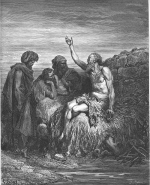 In de derde eeuw v.Chr. werd de Hebreeuwse Bijbel vertaald naar het Grieks, aangezien veel Joden in diaspora het Hebreeuws niet meer beheersten. Deze vertaling heet de Septuagint (LXX). De LXX-vertalers liepen soms tegen hetzelfde probleem aan als hedendaagse vertalers
van de Bijbel: hoe vertaal je een woord waarvan de betekenis onduidelijk is? Vooral hapax legomena (woorden die slechts eenmaal in een taal voorkomen) zorgden voor veel problemen. Zonder een duidelijke context waarbinnen zo’n woord staat, wordt vertalen al snel giswerk.
Deze scriptie behandelt de vertaaltechnieken bij deze tekstproblemen aan de hand van Job 28, een Bijbelhoofdstuk vol dubieuze woorden en metaforen. Centraal staat de vraag welke vertaaltechnieken de LXX-vertalers hebben toegepast op problematische woorden en wat deze vertaaltechnieken ons kunnen leren over de vertalers zelf en over de receptiegeschiedenis van de Hebreeuwse Bijbel. Deze scriptie laat dus zien dat zo’n ĕlologische analyse ons niet alleen iets leert over taalkundige vraagstukken, maar dat wij ook het gedachtegoed van de vertalers kunnen achterhalen. Zo kunnen wij bijvoorbeeld nagaan welke talen de vertalers beheersten en met welke exegeses en tradities zij vertrouwd waren. Zo behandelen wij niet alleen de taalkundige aspecten van vertaaltechniek, maar ook de culturele en theologische aspecten. In onze inleiding beschrijven wij kort de vraagstelling, waarna wij de methodologie bespreken. Hier koppelen wij de ĕlologie aan de theorie van vertaaltechniek. Vervolgens beschrijven we in hoofdstuk 1 wat vertaaltechniek is en behandelen we de kenmerken van bepaalde vertaalmethodes. Op basis van secundaire literatuur bouwen we een theoretisch kader waarin elf vertaaltechnieken worden onderscheiden. Dit kader maakt het mogelijk om iedere vertaling in Job 28 uit te leggen.
In hoofdstuk 2 passen we dit kader aan de hand van een ĕlologische analyse toe op vijftien lemmata in Job 28. We proberen bij het merendeel van de lemmata te achterhalen waarom ze problematisch waren, waarbij we naar etymologie kijken en verbanden trekken met verwante talen. Op deze manier proberen wij de Griekse vertalingen te verklaren en proberen we te achterhalen welke vertaaltechnieken de vertalers gebruikt hebben. Daarnaast biedt deze scriptie, in gevallen waarin de vertalingen bijzonder vreemd lijken, originele verklaringen voor deze vertalingen. Zo zien wij bijvoorbeeld dat de LXX-vertalers Aramees spraken en dat dit invloed heeft gehad op hun vertaling van Hebreeuwse woorden. Ook het feit dat de Hebreeuwse tekst ongevocaliseerd was, heeft eraan bijgedragen dat de vertalers soms woorden verkeerd interpreteerden en er een verkeerde etymologie aan verbonden. Daarnaast zien wij ook verbanden met exegeses die in de Targumim en in de Dode Zee-rollen gevonden worden, wat laat zien dat de Septuagint in een lange traditie van exegeses en lezingen van de Hebreeuwse Bijbel stond.
In onze conclusie laten we zien dat onze analyse ons niet alleen iets leert over de verhouding tussen de Hebreeuwse tekst en de Griekse vertaling, maar ook over hoe de Hebreeuwse Bijbel in de derde eeuw v.Chr. gelezen en begrepen werd. Hierdoor leren wij het gedachtegoed van de vertalers beter kennen en werpen wij meer licht op hoe men destijds de Hebreeuwse Bijbel interpreteerde.
"The thesis is a very good exercise in a difficult topic; translation obliges the author to possess a very high command of both languages, of origin and target alike; this is hardly an easy task for a well-established scholar, let alone a BA student. It is my impression that this particular student has done
an excellent job in this respect, above the level one may expect from a BA student. This thesis certainly has the potential to advance the study of biblical lexicography and translation techniques in the Septuagint. "
BA in Ancient Near Eastern Studies (Egyptology), Leiden University, thesis supervisor: Dr B.J.J. Haring; second reader: Dr M. Müller.
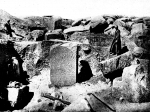 De Vierhonderd Jaar-Stèle is één van de meest raadselachtige monumenten uit de Egyptische geschiedenis. Hoewel potentieel een belangrijke historische bron voor de origine van de beroemde Negentiende Dynastie, confronteert de stèle ons vooral met raadsels en tegenstellingen.
Deze scriptie behandelt de verschillende problematische aspecten van de stèle, en heropent zo de langdurige wetenschappelijke discussie. Centraal staat de vraag wat de historische context en implicaties van het monument zijn. Om deze vraag te beantwoorden is de problematiek rondom de stèle ingedeeld in drie aspecten, die samen de meest terugkerende kwesties in de vakliteratuur dekken.
Allereerst wordt de primaire bron zelf besproken. Een problematisch aspect van dit onderzoek, maar uiterst belangrijk. Aan de hand van een eigen vertaling en uitgebreid commentaar op zowel het aanzien als de tekst van de stèle, worden de meningen uit de wetenschappelijke discussie op kritische wijze tegenover elkaar gezet en geanalyseerd. Hieruit blijkt dat nog veel onzeker is wat betreft de brontekst en de bijgaande scène. De twee andere problematische aspecten worden in het kader van de analyse van de stèle behandelt. De tweede kwestie betreft de identiteit van twee viziers die op de stèle genoemd worden. Deze hoge ambtenaren, genaamd Seti en diens vader Paramessu, werden in de dertiger jaren van de vorige eeuw geïdentificeerd met Seti I en Ramses I. Dit zijn de vader en grootvader van de beroemde Ramses II, onder wiens regering de stèle opgericht lijkt te zijn. Het idee ontstond dat de Vierhonderd Jaar-Stèle een bron kan zijn voor de voor-koninklijke carrière van deze twee koningen. De identificatie tussen viziers en koningen heeft in de wetenschappelijke discussie zowel voor- als tegenstanders, maar in recente literatuur lijkt de identificatie van de viziers als Seti I en Ramses I als meest plausibel naar voren te komen. De stèle wordt in deze literatuur dan ook gebruikt als één van de weinige bronnen voor de voor-koninklijke carrière van deze twee koningen en de vroege Negentiende Dynastie. Op basis van de brontekst en wetenschappelijke discussie tracht ik te beoordelen of deze aanname te rechtvaardigen is. Ik beargumenteer dat er zowel sterke argumenten vóór als tegen de identificatie zijn, maar dat doorslaggevend bewijs ontbreekt. Het is dan ook noodzakelijk om de identificatie niet zonder meer te accepteren. Ten slotte komt de enigmatische datering van het “regeringsjaar vierhonderd van (de god) Seth” aan bod, waaraan de stèle zijn naam te danken heeft. Over de betekenis van deze goddelijke “regering” zijn in de loop der discussie verschillende ideeën geventileerd, die ik vergelijk en analyseer. Hieruit blijkt dat dit aspect verweven is met de identificatie-discussie, en interpretaties van het regeringsjaar slechts hypothetisch zijn.
De Vierhonderd Jaar-Stèle gaat dus gehuld in onzekerheid, wat het formuleren van een historische context ontzettend lastig maakt. Dit heeft grote historische implicaties: één van de weinige bronnen voor de origine van de Negentiende Dynastie wordt in twijfel getrokken. Dit wil absoluut niet zeggen dat de stèle niet een van deze bronnen kan zijn, maar wél dat dit minder zeker is dan in de recente literatuur wordt aangenomen.
"De student laat zo zien dat hij uitstekend wetenschappelijke teksten en theorieën kan beoordelen, en daarin een eigen standpunt in kan nemen dat gebaseerd is op bewijs dat hij zelfstandig geëvalueerd heeft."
Translation: "The student shows excellent judgement of scientific texts and theories, taking his own stance within debates, based on his own independent evaluation of the arguments."
"Een goed verzorgde en zorgvuldig geschreven scriptie die bovendien erg prettig leest."
Translation: "a well-polished and thoughtfully written thesis, which also reads very pleasantly."
MSc in Classics and Ancient Civilizations (Egyptology), Leiden University, thesis supervisor: Dr O.E. Kaper; second reader: Dr T. Sykora.
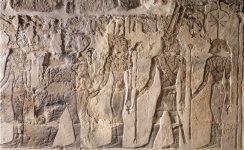 Throughout history, people around the world have been trying to figure out how to remember, depict, or reinterpret the past. Ancient Egypt offers an especially interesting engagement with its past. Archaism, the return to past styles and models that have long been out of use, is a well-documented phenomenon throughout Egyptian history. During the Late Period (664 – 332 BCE), this practice became especially popular. This thesis investigates how, and to what end, this phenomenon occurred in the temples of the 25th, 26th, and 27th Dynasties. Scholars interested in archaism tend to focus on the funerary context of the Late Period. This is unsurprising, as many archaeological remains are available to be studied, such as the monumental 26th Dynasty tombs in the Assasif. While it has been noted that temples from the same period also show archaistic tendencies, no in-depth study of the extent of this practice has been undertaken. Although less material remains from the temples of this period, there is enough evidence to offer more insight into the decorative programme of these temples and how archaism is employed. The first chapter of this thesis provides a discussion on the broader phenomenon of archaism before and during the Late Period outside of the temple context. The second, third, and fourth chapters are dedicated to the analysis of the available Late Period temple material. This selection of material is used to show that, although the temple decoration certainly shows archaising tendencies, the shape in which this occurs is very much different from what we see in the funerary context from the same period. Funerary monuments, such as the tombs of Harwa, Montuemhat, and Padiamenope in the Theban necropolis, combined specific textual and iconographic motifs from various periods (Old, Middle, and New Kingdom). Their decorative programmes show a creative engagement with this ancient material, which goes further than merely copying certain motifs.
The scenes depicted on the temple walls, on the other hand, almost completely follow New Kingdom tradition, showing a more restrained use of archaism. The decoration gets a distinctly archaising character through the reintroduction of certain artistic conventions from the Old Kingdom, such as the proportions and clothing of the figures. Additionally, a new type of scene is introduced in the Saite Period, which might be inspired by the Old Kingdom mortuary temples. Archaising elements were an effective way to use the past to project the image of a traditional Egyptian pharaoh. This alignment with the past offered legitimacy that was especially valuable for foreign kings such as the Kushites and the Persians on the one hand, and the Saites, trying to re-establish Egyptian identity, on the other. This thesis shows that the study of Late Period temple archaism offers much more than an overview of the revival of certain styles and motifs. It provides insight into how the Egyptians defined themselves through time and made use of their past, especially in the changing political landscape of the Late Period.
"In haar scriptie heeft ze een indrukwekkende hoeveelheid iconografisch bronmateriaal verzameld, bestaande uit zowel gepubliceerd als ongepubliceerd materiaal dat bovendien afkomstig is uit diverse vindplaatsen verspreid over Egypte."
Translation: "For her thesis, she has compiled an impressive amount of iconographic source material, both of published and unpublished material, originating from various sites distributed across Egypt."
"De studente toont een groot inzicht in bekende en minder bekende decoratiemotieven in tempels."
Translation: "The student demonstrates considerable insight into both well-known and lesser-known decorative motifs in temples."